
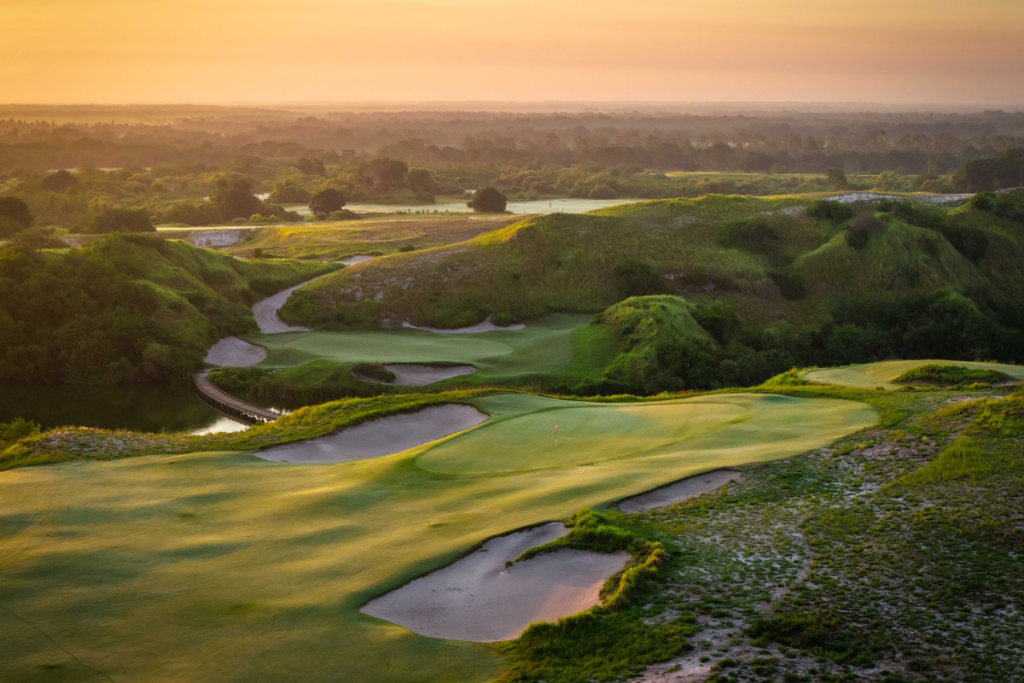
When you think of Florida golf, chances are you’re thinking palm trees, housing developments and a couple of carts waiting on every tee box.
Streamsong is none of those things.
Built on former phosphate mining land in the middle of Central Florida, the resort has the scale, movement and isolation of a golf destination much farther from home. There are no houses lining the fairways, no traffic cutting through the property and very few reminders that Tampa and Orlando are both about 90 minutes away.
More importantly, Streamsong was built to be walked.
That puts it in a relatively small group of American golf resorts where walking is not merely allowed but central to the experience. Red, Blue and Black each move across dramatic ground that looks nothing like the flat Florida golf most people know. The Chain adds a shorter, looser round to the schedule. And soon, Bone Valley will give golfers another full-length course designed by David McLay Kidd.
Streamsong was already capable of carrying an entire golf trip. With Bone Valley on the way, it is becoming the kind of destination where the bigger challenge may be deciding what not to play.
Why Walk?
Having grown up playing the game from a young age, carts weren’t an option early on. When we were able to get our hands on one, we’d stick a pencil or a twig in it to disengage the governor, thus exemplifying why 14-year-olds shouldn’t be trusted with heavy machinery.
The point is, I learned the game by walking from tee to green, green to tee and everywhere in between. I highly recommend it if you haven’t tried it.
Walking a course changes the rhythm of the round. You see more of the property, understand how one hole leads into the next and have time to forget about the shot you just buried in a bunker. At Streamsong, that is especially important because the land is the whole point.
I’m a firm believer that we should all enjoy the game the way we want to. Some of you will love the walking-first culture. Some of you will complain about it for four hours and probably won’t get invited on the next trip.
Built for Walking
Some courses simply aren’t made to be walked. Many built over the last few decades prioritized the housing development around them, with the course routing becoming an afterthought. The result is a quarter-mile trek between holes and a guaranteed six-hour pace if everyone walked.
Streamsong doesn’t fall into that category.
The resort’s original three courses were designed by Coore and Crenshaw, Tom Doak, and Gil Hanse and Jim Wagner. Each uses the same unusual piece of Florida differently, giving you three distinct rounds without leaving the property.
Three Courses, Three Different Walks
Streamsong Red and Blue opened together in 2012, followed by Streamsong Black in 2017. They share the same property, but they aren’t interchangeable rounds.
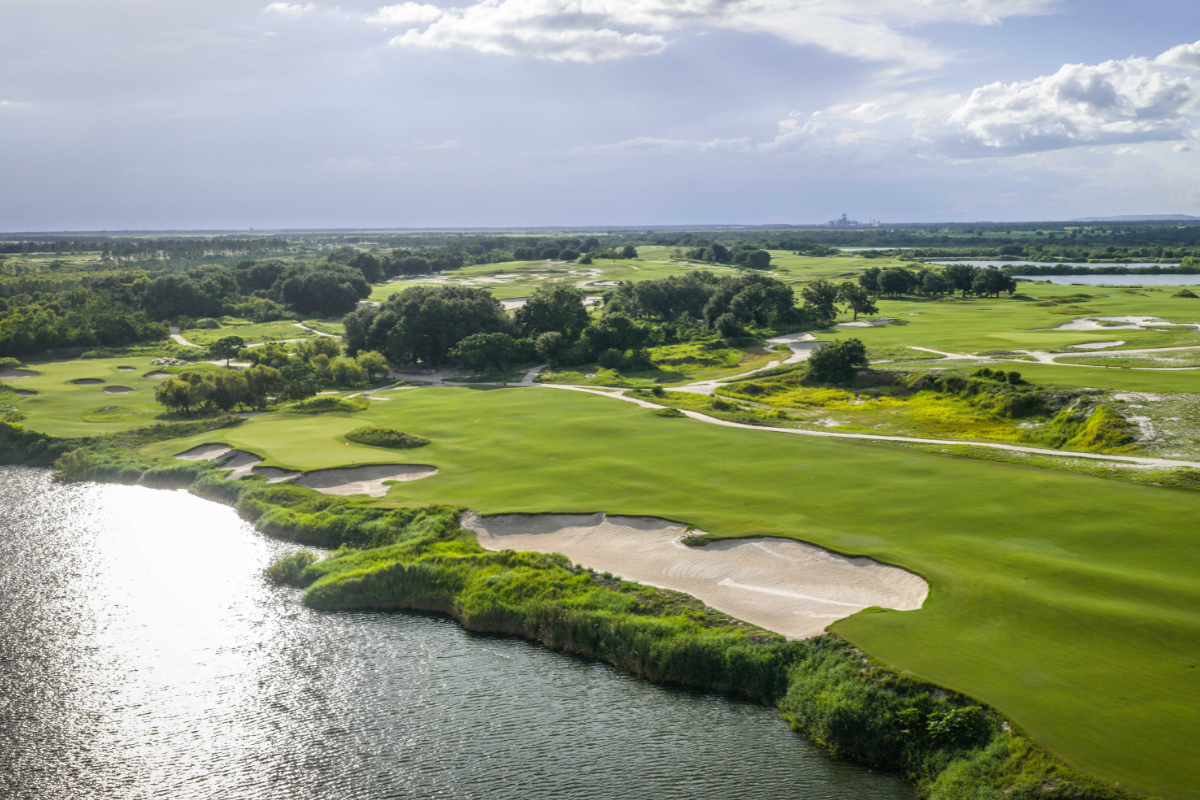
Streamsong Red
Designed by Bill Coore and Ben Crenshaw, Red winds through dunes, water and some of the property’s most unusual landforms. Strategy drives the design. The best route isn’t always the most obvious one, and choosing the right angle can matter more than simply hitting it farther.
The course begins with an uphill par 4 framed by dunes and builds toward a strong closing stretch. That includes the long par-4 15th and the Biarritz-style 16th, featuring a large green split by a deep swale. Red is the type of course that makes more sense as you walk it. The ground between your ball and the hole matters, and you get a much better look at it when you aren’t driving past most of it.

Streamsong Blue
Tom Doak’s Blue makes its first impression immediately. The opening tee sits at the highest point on the property, providing a view across Streamsong before the course drops into the dunes, wild grasses and deep-water ponds below.
Blue gives golfers choices throughout the round. The par-4 third, for example, lets you challenge the water from the tee in exchange for a better angle into the green. Later, the par-3 seventh plays across water to a green surrounded by dunes. It serves as a sister hole to Red’s 16th, tying the two original courses together without making them feel the same. The routing follows the natural movement of the property, which is exactly what you want from a course designed to be traveled on foot.
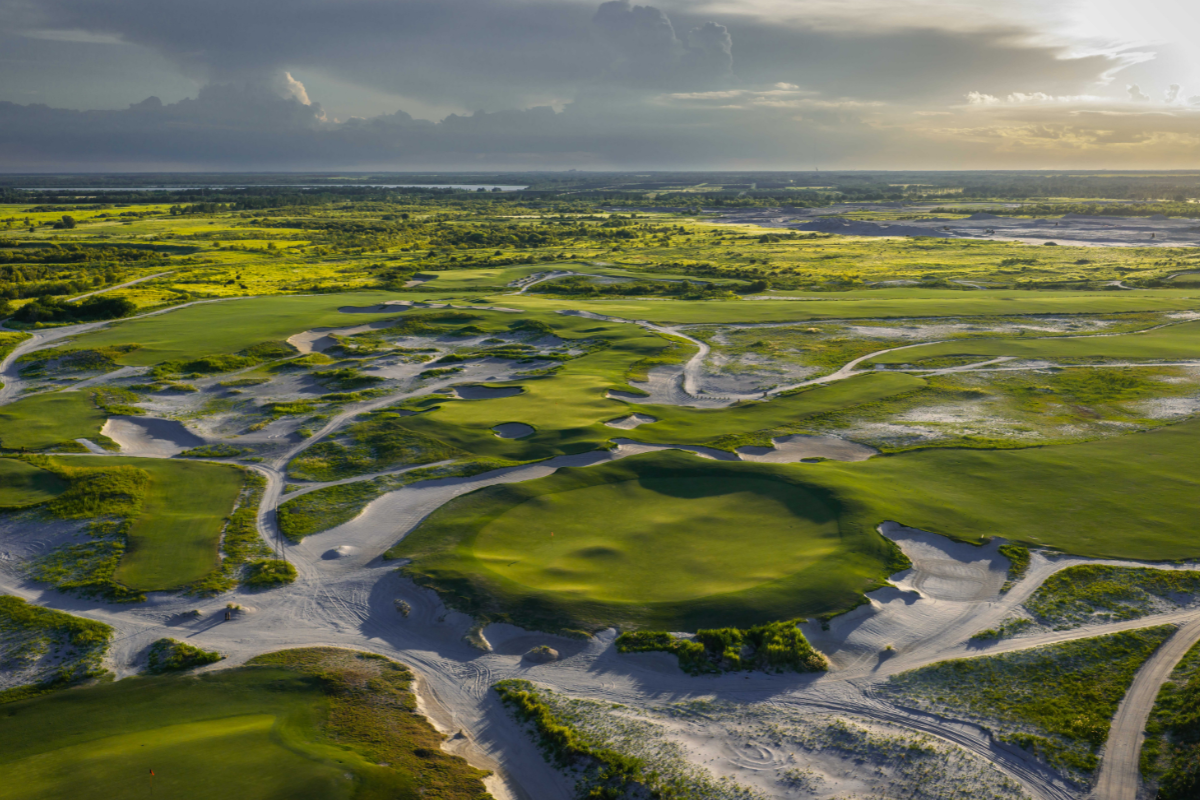
Streamsong Black
Streamsong Black is the biggest and boldest of the three.
Designed by Gil Hanse and Jim Wagner, the course moves across a broader landscape filled with large bunkers, wide playing corridors and heavily contoured greens. Its size gives golfers room to play, but that room can be misleading. Finding the wrong section of a fairway or green can leave you with a much harder next shot.
Black also asks more of you physically. It is a substantial walk across rolling terrain, so this probably isn’t the round to schedule after walking 18 that morning unless your group knows exactly what it is getting into. The course’s scale is part of what makes it memorable. So are holes like the ninth, which finishes at a punchbowl green reached by a partially blind approach, and the par-3 17th, which plays downhill from a massive oak tree.

The Chain
Not every round at Streamsong needs to involve 18 full-length holes.
The Chain is a 19-hole short course from Coore and Crenshaw with no fixed tees and no assigned par. Golfers can choose where to play from, adjust the challenge and settle the format themselves. It was built for match play, creativity and the kind of golf where keeping an official score starts to feel beside the point.
Its first six holes, known as The Link, can also be played as a separate loop. The Link is complimentary for resort guests and available on a first-come, first-served basis, making it an easy addition after another round or before heading home. The Chain shouldn’t be treated as something to play only if there’s extra time. It is exactly the type of lower-pressure round that can keep a golf trip from becoming four straight days of grinding over every five-footer.
Bone Valley Is Next
Streamsong’s next full-length course is Bone Valley, designed by David McLay Kidd.
Kidd already has some serious destination-golf credentials, including the original course at Bandon Dunes and Mammoth Dunes at Sand Valley. At Streamsong, his course follows the property’s natural ridgelines and bowls across another piece of the former mining landscape.
Limited preview play is being offered starting next month, with the official grand opening scheduled for January 2027. Once it opens, Streamsong will have four full-length courses from four of the most prominent names in modern golf architecture, plus The Chain.
That creates a good problem for anyone planning a trip. Three days may no longer be enough.