
Remember when streaming was supposed to save us from cable TV?
Hundreds of channels, most of which you never watched, and a monthly bill that somehow kept getting bigger. Streaming offered a better deal. Pay a fraction of the price, watch what you wanted, when you wanted, and forget about the rest.
You called your cable company and gave them the old “it’s not you, it’s me” routine. You stayed on the line for a brief survey after the call, and were set free to roam the streaming services to your heart’s content.
And for a while, it worked.
Then media companies realized they could make more money controlling their own content. Shows and movies started disappearing from one platform and reappearing on another. Before long, everyone had their own streaming service, and the simplicity that made streaming so appealing began to disappear.
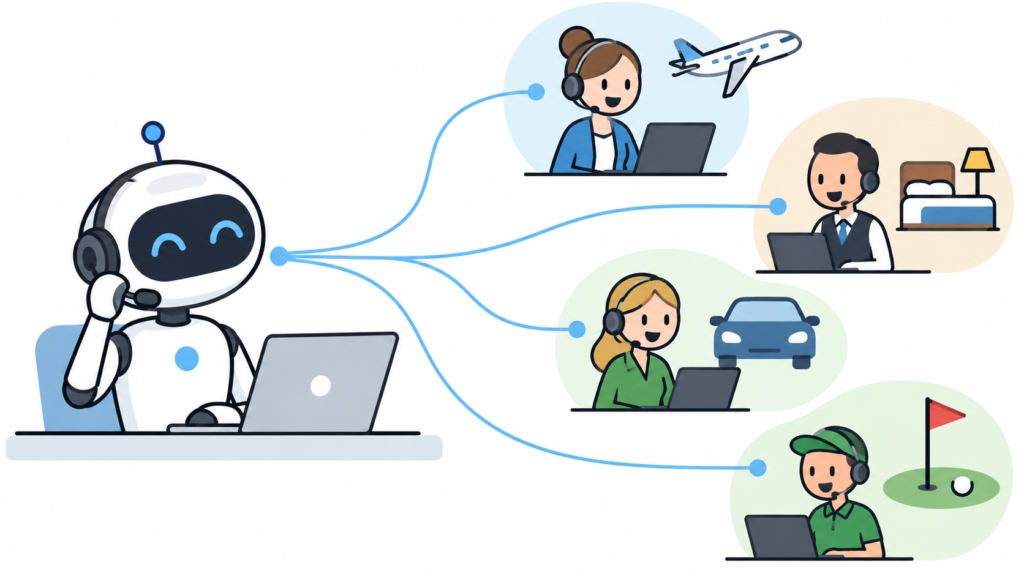
Now imagine you’re planning a golf trip. You and your AI assistant work hard to put together a high-level itinerary that you’re happy with. All that’s left to do is book. Book the flights. Book the lodging. Book the transportation. Book the tee times.
You start to think how great it would be if the AI assistant that helped plan the trip could just go ahead and book the whole thing.
We’re getting closer to that reality. But there’s a reason to wonder whether the companies involved will be quite as excited about making it happen as the people booking the trips.
AI Booking Is Already Taking Shape
We’re already seeing the early stages of AI-powered travel booking. Google recently introduced the ability to book hotels directly through its AI search experience, working with partners including Hilton, Marriott, Expedia, and Booking.com. Travelers can research hotels and complete a reservation without bouncing between a dozen different browser tabs and a Travelocity pop-up window they discover two days later.
That’s a pretty significant development, even if we are a long way from having an AI assistant book an entire golf trip from its inception.
But AI agents are already running into some limitations, and they have less to do with the technology than the companies they’re trying to work with.
Meta’s Muse can perform tasks across websites on a user’s behalf. Amazon has already blocked the agent from making purchases on its site, citing concerns about authorization and customer information. Shopify, on the other hand, has partnered with Meta to allow purchases through Shop Pay.
Two very different responses to the same platform.
And when you consider the business model of each, neither response is particularly surprising.
Amazon has spent decades building a platform where consumers can search, compare, and order products to show up on their doorstep. It makes money from the transactions, but also from the advertising and customer data that comes with them. Naturally, it wouldn’t be too eager to hand that experience over to a competitor’s AI assistant.
Shopify’s business is different. People aren’t scrolling their Shopify feed or doing in depth analyses of products and reviews in the platform. Shopify provides the infrastructure for merchants to sell their products. If an outside AI agent helps those merchants make more sales, there’s an incentive to cooperate.
Of course, there are legitimate security and privacy concerns with allowing AI agents to make purchases. But there is also plenty of money at stake.
Who Controls the Booking?
Now consider the travel industry. Hotels want direct bookings. Airlines want people booking directly through their websites and apps. Online travel agencies want customers comparing and booking through platforms. And the companies developing AI assistants want to become the place where people go to do all these things.
There is an incentive for everyone to cooperate, but there are also plenty of reasons for each company to protect its piece of the business.
Radisson Hotel Group, for example has already developed a ChatGPT integration that helps travelers discover properties and compare prices before completing their reservation on Radisson’s own website. That’s a model where both companies can benefit without the hotel giving up the actual booking.
Other companies may be less enthusiastic about opening their systems to outside agents. And that’s where I start to wonder if we’re headed toward the AI version of the streaming wars.
Will AI Make Travel Easier or Just Different?
Imagine the AI assistant you’ve spent an hour planning your golf trip with can book your flights but can only access lodging at one of the three different hotels you’re staying at. Or it can book your rental car through certain partners but needs to send you somewhere else for others.
Maybe another AI platform has those connections. Maybe the resort has its own assistant that can handle its rooms and golf packages but can’t coordinate anything outside of the property.
Suddenly, you’re back to visiting multiple platforms to complete one trip. The experience may be more sophisticated than the collection of websites we use today, but it isn’t necessarily much simpler.
The obvious answer to travel fragmentation is a single AI assistant that can work across all of it. Booking Holdings appears to understand that. Its newly announced Vayo agent promises to organize reservations from different travel providers, including those outside Booking’s own portfolio, and manage the moving pieces of a trip in one place.
But even that raises another question: if Booking, Expedia, Google, OpenAI, and others all want to become that one interface that organizes everything, have we eliminated the fragmentation or simply moved it up a layer?
If one resort is easier for an AI assistant to book, does that influence which one gets recommended in the first place?
We don’t know yet how much booking access will influence AI recommendations. But as discovering and booking travel become more closely connected, it’s a question worth asking.
Travel companies already distribute their inventory through multiple channels, and there’s plenty of financial incentive to make booking easier. That could work in AI’s favor. Hotels, airlines, and booking platforms may find that cooperating with AI assistants brings them more customers than trying to keep everything within their own systems.
I hope that’s what happens. Being able to plan and book an entire trip through one conversation would be a remarkable improvement over what we’ve had the past several decades.
But the technology is only part of the equation. The companies controlling the reservations, payments, customer relationships, and access to their systems will have the ultimate say in how it all works.
Streaming showed us what can happen with the promise of convenience runs into the business of controlling the customer.
It will be interesting to see whether travel learns anything from it.
Fairways & Dreams helps golf resorts find more golfers and golfers plan better trips. We combine marketing experience with firsthand knowledge of golf travel to help resorts reach the right audiences and travelers make the most of their time on and off the course.